Technology is not something I generally avoid.
I use online banking, manage several devices, search the internet, and use ChatGPT almost every day.
I make an effort to keep up.
And still, there are moments when something that should be simple becomes ridiculously difficult.
Connecting a device to Wi-Fi.
Installing an update on my phone, television, or computer.
Finding a setting that the instructions insist should be right there.
What should take five minutes turns into an hour. The screen in front of me does not match the one being described. One solution creates another problem.
Eventually, I am no longer frustrated with the device.
Why can I not figure this out?
Am I missing something obvious?
Sometimes I genuinely feel as though I am losing my mind.
It sounds dramatic, but the problem is no longer the Wi-Fi.
It is what the Wi-Fi suddenly seems to be saying about me.
For most of my adult life, I have been comfortable solving problems. Even when I did not know the answer, I usually knew how to find it.
I see that clearly in men around me who are every bit as capable as they have always been.
They are not unintelligent, lazy, or refusing to learn.
But the world is increasingly asking many of us to operate in a language we were never taught.
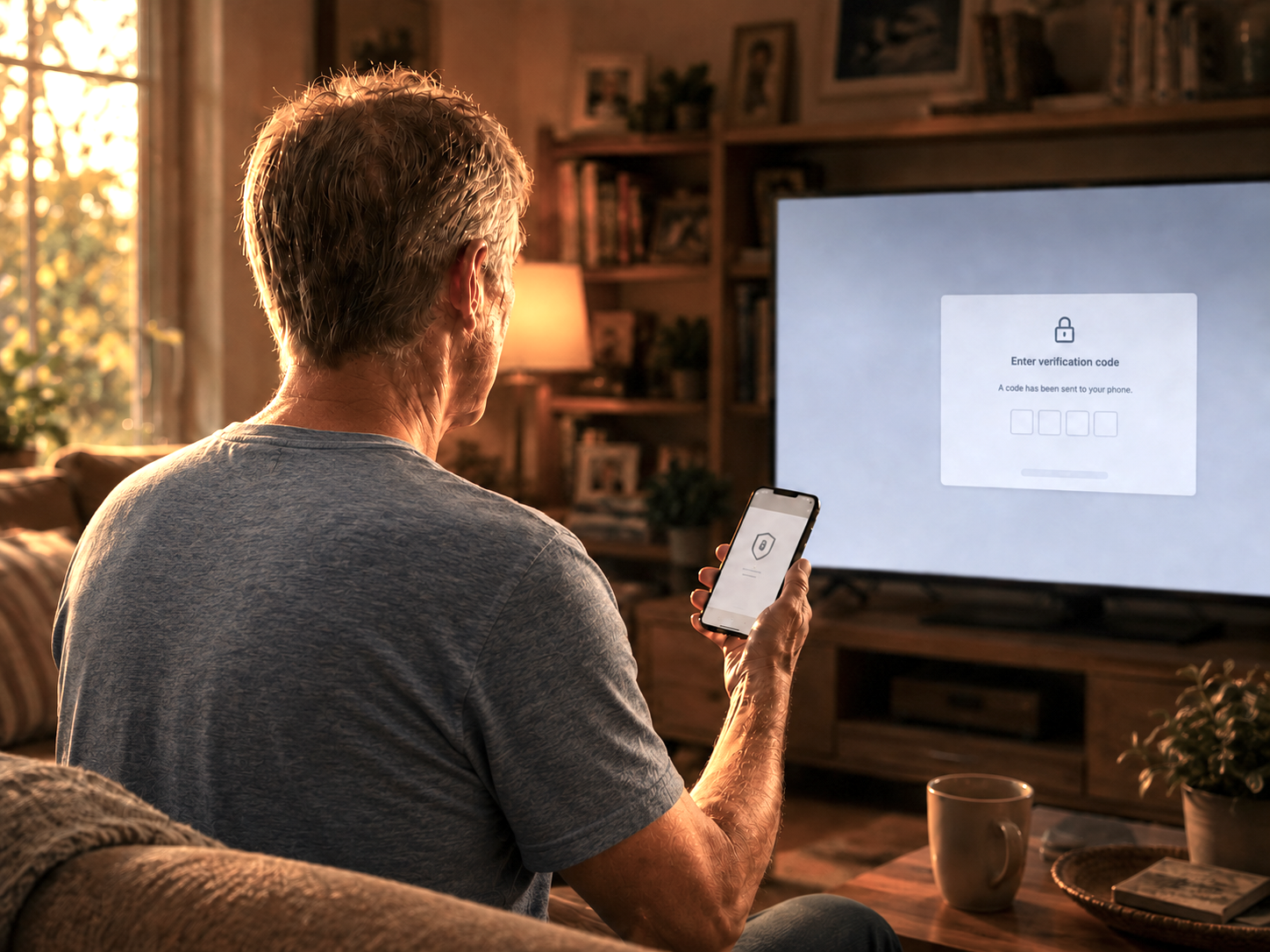
Banking requires two-step authentication.
Medical information arrives through a portal that requires cookies to be enabled.
An event ticket appears on a phone and then asks whether to save it in a digital wallet.
Every account needs a password, then a verification code, then another device to prove that we really are ourselves.
Just when we learn how something works, the company changes the screen.
On top of that, we are expected to decide whether an email is genuine, whether a text is a scam, and whether the confident voice on the phone is telling the truth.
Recently, someone in our family circle was persuaded to transfer $600 after receiving a convincing phone call.
Stories like that can push people in opposite directions.
Some men stop trusting almost everything. They avoid online banking, apps, email, and artificial intelligence because shutting it all down feels safer.
Others trust too easily.
For most of our lives, it was reasonable to assume that an official-looking letter came from an official organization. A confident person from the bank was probably from the bank. Most people were generally honest about who they were.
Now a polished message might be fake.
An authoritative voice might belong to a scammer.
ChatGPT can produce an answer that sounds certain and is still wrong.
Technology seems to punish us at both ends.
Fear can make our world smaller.
Blind trust can leave us exposed.
I am finding that the safest response is often the simplest one: stop, ask, and make sure before moving ahead.
The asking part matters.
Many men spent their lives being the people others came to for answers.
They fixed things.
They made decisions.
They gave directions.
Now they may be staring at a phone, wondering why an app will not open or whether a text message is genuine.
I can understand why that might feel embarrassing.
The world changed quickly. The language changed. The risks changed. Even people who work hard to keep up are sometimes left staring at a screen with no idea what it wants from them.
For me, the answer is not to understand all of it.
I spent most of my life being the person expected to find the answer.
Retirement has not changed that instinct.
But it may be changing what being capable looks like.
Sometimes it still means solving the problem. Sometimes it means knowing when I need help.
I am still getting used to that.
Jim O’Grady writes The Post Game, a newsletter about life in the GoGo years. He lives in White Rock, BC.